12.09.2012

India: At the Starbucks, or the Starbucks, or the Starbucks, or the Starbucks

Anyone get that reference in the post title?  If not, catch up here.  While Mumbai, and all of India, for that matter, is a long way from being like Arlington, Starbucks has arrived and is multiplying across town.


I'm still mildly disappointed in myself for seeking out this ubiquitous American enterprise.  See, on my first trip here I had to bitterly accept that India is a tea, not coffee, nation.  On the second trip, my willingness to drink everything from weak Americanos to Nescafe all for the caffeine hit was a badge of honor.  I also kind of enjoyed the fact that India was one of the last corners of the Earth to not have green mermaids swimming about everywhere.  That all changed when Starbucks and Tata finally came to an agreement a few months ago.  More on Tata's ubiquity later; it makes Starbucks look like your local mom-and-pop shop.

Anyway, Matt's hankering for better-than-passable coffee led us to Starbucks in Horniman Circle.  This place is absolutely huge and I'll admit it was also a fair amount of curiosity that drew us in.  Like McDonald's french fries, would Starbucks coffee taste the same the world around?  Answer: yes.  But how you get that coffee is a much different experience.  Let's review.

Chances are most of you get your coffee hit in less than 60 seconds' time.  Your cup is tattooed with your preferred brew and you have probably mastered putting your credit card away with one hand as you dump cream and sugar in your drink with the other.  None of this is holds in India.

Matt and I placed orders for short and grande brewed coffees.  Simple order, yes?  It required filling out a form.  I'm not kidding.  India has proven itself to be the king of "Sign here, press hard, third copy's yours" paperwork, where everything is handwritten and done in triplicate.  Apparently, even Starbucks, the company that pioneered paperwork on paper cups, can't avoid this kind of documentation.  

Here, short has replaced tall and porcelain mugs are the go-tos instead of paper cups.  We know this
because one of the eight people behind this counter (there were two other stations inside) whispered to the barista taking our orders, "They're Americans, they probably want paper."  Only Matt heard this and I don't know if he interjected but we ended up with porcelain mugs anyway. 

After you get your form from Barista #1, step over four paces and give it to the cashier, Barista #2.  Pay.  Then go somewhere else to wait.  Your drip coffee will be brought to you in "just two minutes."

Some time later, your coffee shows up.  Invariably, you start looking for the cream and sugar stand.  Good luck finding it!  After wandering about I was intercepted by another barista from one of the other coffee bars asking if I would like milk for my coffee.  

-Yes, indeed I would.  
- Hot or cold, I'm asked.  
- Hot. Let's kill off anything questionable.  
- Sure, just two minutes, madam.

Some time later, your hot milk shows up.  You might be looking for a stir stick or something but recall that the cream and sugar stand, which also holds stir sticks, doesn't exist.  May as well just have a seat and hope a gentle swirling of your cup does the trick. 


So, what's the verdict?  After one or two quick hits, I mean sips, Matt appears sated.   And, for today's nerdy term, let's throw out Purchasing Power Parity.  In a land where most food is comparatively cheap and alcohol is horrifyingly expensive (see also: Yellow Tail wine at $36 a bottle), a 12 oz. cup of Starbucks coffee will set you back Rs. 95, or roughly $1.74.  


Finally, I'll share a picture of the hand painted Starbucks logo on the shop window.  This caught my eye because I've noticed that in India, more often than not, signage is hand painted and hand lettered.  Peel-and-stick vinyl graphics aren't huge here for reasons unknown to me.  Might be the whole labor situation: people are still cheaper than automated manufacturing.  In any case, even Starbucks went local on this account.  The picture doesn't do it justice, but the craftsmanship on the giant logo was more beautiful than the other pseudo-artwork throughout the shop!

12.06.2012

India: Weekday Outing - Elephanta Island

Are you all ready for this shake-up?  A weekDAY outing instead of a weekEND outing.  I know, crazy, but that's what happens when you go on vacation, apparently.  You can do stuff during the week!

Thursday morning brought me right back into my Mumbai routine: morning run along Marine Drive, breakfast at Frangipani, then pack up the adult diaper bag and head out for a day of sightseeing/getting lost in the city.  The fun addition this go around was of getting to do this with someone else, save for the running on Marine Drive.  Matt welcomed the opportunity to sleep more while I tested how many faces I recognized in saris and tennis shoes.  Answer?  A surprisingly high amount!

Our destination du jour was Elephanta Island, which you reach by taking any number of rickety old wooden boats on a ride 45 minutes across the bay.  I'd tell you about the island's history but alas, we did not hire a "tour guide" nor did we buy a "guide book" while there.  And yes, those quotation marks are to be read in a mocking tone.  Instead, we came, we saw, then Matt Wikipedia-ed it.  Good enough for who it's for.

As we embarked on our trip, Matt delivered one of the better lines of the trip:

Oh nice, a wooden hull boat.  It would take one big rock to smash this thing in and capsize us.  Of course, the good news is there would be a rock for all of us to stand on.

Sound and optimistic logic, indeed.

We made it across the bay without running into any rocks.  Upon reaching the island, you walk alongside tons of locals selling all sorts of goodies and trinkets.  Spiced pickles appeared to be the favored treat and a cow, goat, monkey, rooster, or stray dog will gladly take your leftovers.  You're also kindly asked to keep your elephanta clean.  This is humorous for a couple of reasons, not the least of which is the trash dump located within sight of the requesting signage.  And then there's just something funny about being asked to keep your elephanta clean, no? 

At the end of the pier, you reach the equivalent of an outdoor strip mall perched along both sides of a massive set of stairs that one must climb to get to the ticketing office.  Perhaps you'll be so delighted by the trinkets that you don't even make it to the apex?  Whatever floats your wooden hull boat, I guess.

We climbed and climbed and then huffed and puffed before buying tickets.  That transaction entailed giving one guy on the side of a shack our money and in return, he gave us paper tickets.  Next, we turned 90 degrees, walked 5 paces, and gave said paper tickets to another guy.  He took them, passed them to guy number three, and guy number three nodded us through the gate while he passed the paper back to guy number one.  Ahh, the whole toll booth staffing strategy appears to be consistent throughout this nation.

Once through the gate, you are free to walk about the paths and explore five caves in various stages of restoration (read: recreation through modern-day concrete and re-bar).  


Even if authenticity wasn't the wow factor, the scale of some of the caves certainly gave you pause.  While we enjoyed wandering through the caves, we found ourselves more interested in yet another hike up a hillside to two old canons.  I'd share a picture of the view but Mumbai smog plus a modest camera lens didn't amount to much.

Now, before we leave the island, note that I mentioned monkeys at the beginning of this tale.  Elephanta is known for its hordes of monkeys and they were everywhere.  So much so, in fact, that signs warned visitors to beware of them!  We did see a few aggressive ones go after tourists' lunches.  Given my track record with monkeys and cameras, you'd think that I'd finally capitalize on the chance to get a monkey photo without being harassed.  I guess I do better under pressure because the below image is all I got.  Weak.  I promise you there are monkeys in the shot.


After a full day of hiking and boating, we returned to South Mumbai and went to The Strand for rooftop beer and snacks.  Under a full moon and with a raucous wedding band providing the soundtrack, you can't ask for a better way to end the night!


12.04.2012

India: A Whole Lotta Culture

By Tuesday morning it was time to wrap up our sightseeing, say goodbye to Anil, and head south to Pune for Chinmay's wedding before ultimately making it to Mumbai.  Candidly, I was also ready to stop feeling like a chauffeured tourist and wanted to blur into the background (as best one can when still clearly a foreigner).  Heading out of Jaipur airport gave us the first opportunity of the trip to just run with things.

No need to fully retell the domestic flying experience but I will say that the security process did not fail to baffle us.  Thank goodness we had a three hour layover in Ahmedabad because you must fully exit the airport, walk outside, come back inside, go through security, and then come back upstairs only to return to the gate that you literally just walked out of from the incoming plane.  No joke.  Oh, and remember my amusement at Indigo's in-flight magazine?  I have been vindicated, friends, because as soon as the flight attendant announced its name on the PA system, Matt turned to me and said, "Wait, what's the name?  'Hello 6E'?  Like, 'Hello, sexy?'"  Bwahahahahahaha!  Yes!  I'm not the only one who cracks up at this!

Amusement aside, we arrived in Pune exactly on time and all checked baggage was in tact.  Serious victory!  A car from the hotel picked us up and off we went.  I had never been to Pune before and it's not exactly a touristy town, lovely as it may be.  Before dinner, Matt and I went out wandering around and completely stuck out from the crowd.  Whereas in Mumbai and Delhi you get a fair amount of Westerners roaming about for work or holiday, that didn't appear to be the case in Pune.  We had a great time partaking in one of my favorite games in India: let's see if we can get lost.  After an hour or so of wandering aimlessly we hailed a tuk-tuk for the short ride back to the hotel.


Kids, these things are total deathtraps and yet so much fun.  Remember all the very cool things we had just seen in the North?  Well, that's all fine and good but Matt's ongoing requests to commandeer a tuk-tuk for future transportation needs clearly exposed this as the highlight of his trip so far.

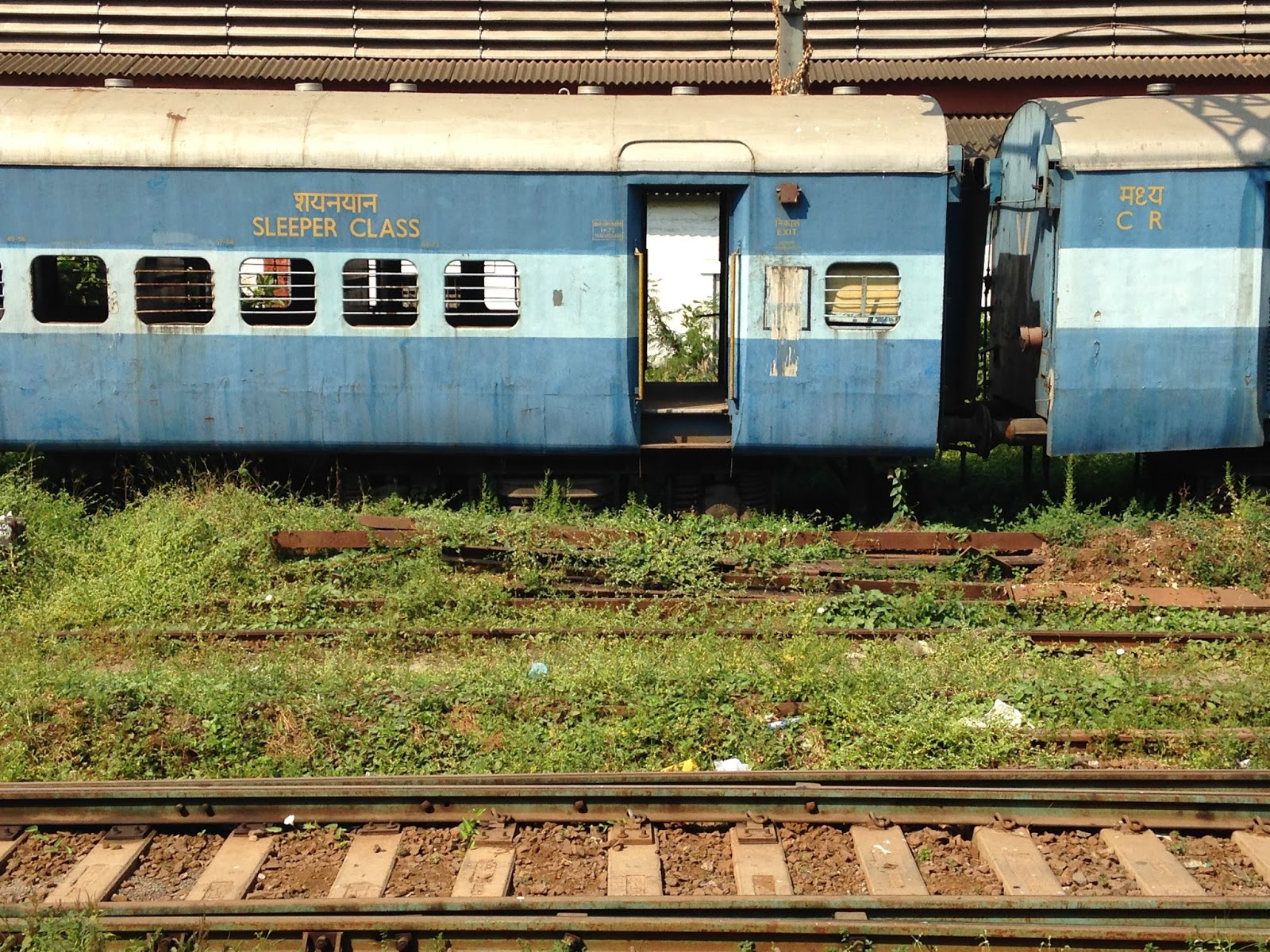
Wednesday morning we awoke to Pune commuters racing to the trains.  A Central Railway station was directly across from our hotel and provided an active play outside our window.

Following breakfast, it was time to assemble ourselves for the wedding.  And I do mean "assemble."  Matt had a kurta, pyjamas, and scarf to don while I had a sari that needed professional draping.  No amount of YouTubing was going to get all that fabric where it needed to be so I enlisted the help of a duty manager named Elizabeth.  Twenty minutes and four discreetly placed safety pins later, we were ready to roll.  Ta da!


As soon as we arrived at the wedding Chinmay's dad greeted us at the front of the wedding hall and pulled us inside.  Within moments, Matt was in a corner of the room having his head wrapped up in a traditional hat (if you call it that?) that all the men on the groom's side wore.  The bride's side wore a similar confection but in different colors and one of Chinmay's uncles explained to us that the hats were analogous to wearing boutonnieres in Western weddings.  Do I need to declare that Matt loved his hat or does the huge grin give it away?


As for the wedding itself, it was a spectacle.  Stimulation overload, like India in general.  Music's blaring non-stop, flowers are hanging throughout the space, spices from lunch are wafting through the air, color is exploding on the floor in sand art and in the hundreds of saris swishing about.


I wish I could tell you about everything that was happening and what it all meant but Matt and I were generally lost on that front.  Another uncle graciously explained the rituals and the traditions as they took place but there was so much happening at once and so many people buzzing about we only captured about a quarter of what he told us.  But here again, even though we stuck out wildly (as demonstrated by the handfuls of other guests covertly or not-so-covertly taking pictures of us), we also felt warmly welcomed and wholly included in the day's events.  


While Kirti and Chinmay participated in the rituals, guests hovered around the altar/stage and snapped endless photos while talking and laughing.  People were dressed in their finery or in jeans - it didn't seem to matter!  Later on I decided that in the US, we seem to convey a wedding's importance through its formality: processionals with classical (and sometimes somber sounding) music, no talking or moving around during the ceremony,  everyone in their fancy clothes, prescribed seating arrangements at dinner, and on and on.  Throw all that out the window in India but don't let the revelry fool you into thinking this isn't a serious affair.


The wedding and receiving line/picture taking extravaganza concluded in the early afternoon and shortly thereafter, Matt and I hopped in a car and embarked on the four hour drive to Mumbai.  Along the way we talked about all that we had just seen and experienced, marveling at marriage in India.  Chinmay and Kirti had a love marriage as opposed to the more common, but dwindling, arranged marriage.  I always feel strange labeling one person's marriage as "love" versus "arranged," as if to say the latter is void of the former's emotions, but this is common parlance here.  Anil talked to us about marriage after he learned we were attending a wedding.  To him, arranged marriages are a lottery and if you win, it's okay.  But if you don't win, it's also okay.  Matt politely chuckled at this statement and while I also smiled, I was more taken by the idea that in India, you are encouraged to apply this line of thinking to pretty much everything: either way, in the end, it's okay.


By the way, Anil never told us if he had won the lottery in his arranged marriage and we weren't about to ask.

12.02.2012

India: Jaipur in Pictures

We're going to keep rolling with the pictures rather than the words because Jaipur was equally, but differently, as stunning as what we saw in Agra. Some quick notes before we get to those, though.


Jaipur is in the neighboring state of Rajasthan and is about another 5 hour car ride from Agra.  It is often called the Pink City (you'll see why below) and if I were to compare it to another city, it reminds me of St. Petersburg, Russia: Imperial architecture in ice cream colors, a vibrant culture, and is fairly easily to navigate due to urban planning foresight.  We reached the city Sunday evening, checked into our hotel, and passed out.  Monday morning we planned to meet Anil at 9 am and then headed out for a handful of sites: Amber Fort, City Palace, Jai Mahal, and some shops.  Handicrafts are big in Jaipur and hand-knotted carpets, jewelry, and textiles rule the city.  We really enjoyed our time in Jaipur and were glad we gave that city the biggest chunk of our time while in the north.

To the pictures!

Oh, you know, just a camel on the side of the road.

School kids on a field trip to Amber Fort.

Amber Fort.

You can walk to the top...

...or ride an elephant!

The line for elephants was crazy long so we walked - and got just as close to the animals as the riders!

City of Amber viewed from the fort.


Entry court, elephant valet in background.

Elephants are kind of a big deal in this country.  Note the elephant tusk detail in the column corbel.

Palace gardens.

Elephant traffic jam.  Elephants don't stay in their lanes in India, either.

Walls of the "Pleasure Palace" room.  An early form of air-conditioning was designed in this space using evaporative cooling.


Across the way, a hall made of millions of mirror fragments.

Jali


Jai Mahal.  You can look but not touch.


 Handknotting a rug.  Estimated date of completion?  June 2013.

 Wool yarn hung above and pulled as needed. 
Jaipur city and one of the many gates surrounding it.


Inside the City Palace.

 More painted spaces inside City Palace.

 Architecture nerd term of the day: enfilade.

 As Matt pointed out, even 21st century royalty needs DirecTV.

  *******
IF YOU GO:  We stayed at the ITC Rajputana hotel and it was excellent.  The audio guides at the major monuments are more than satisfactory so stick with those over the live versions.  We spent over 3 hours exploring Amber Fort on our own and didn't feel slighted in the least.  
Related Posts with Thumbnails